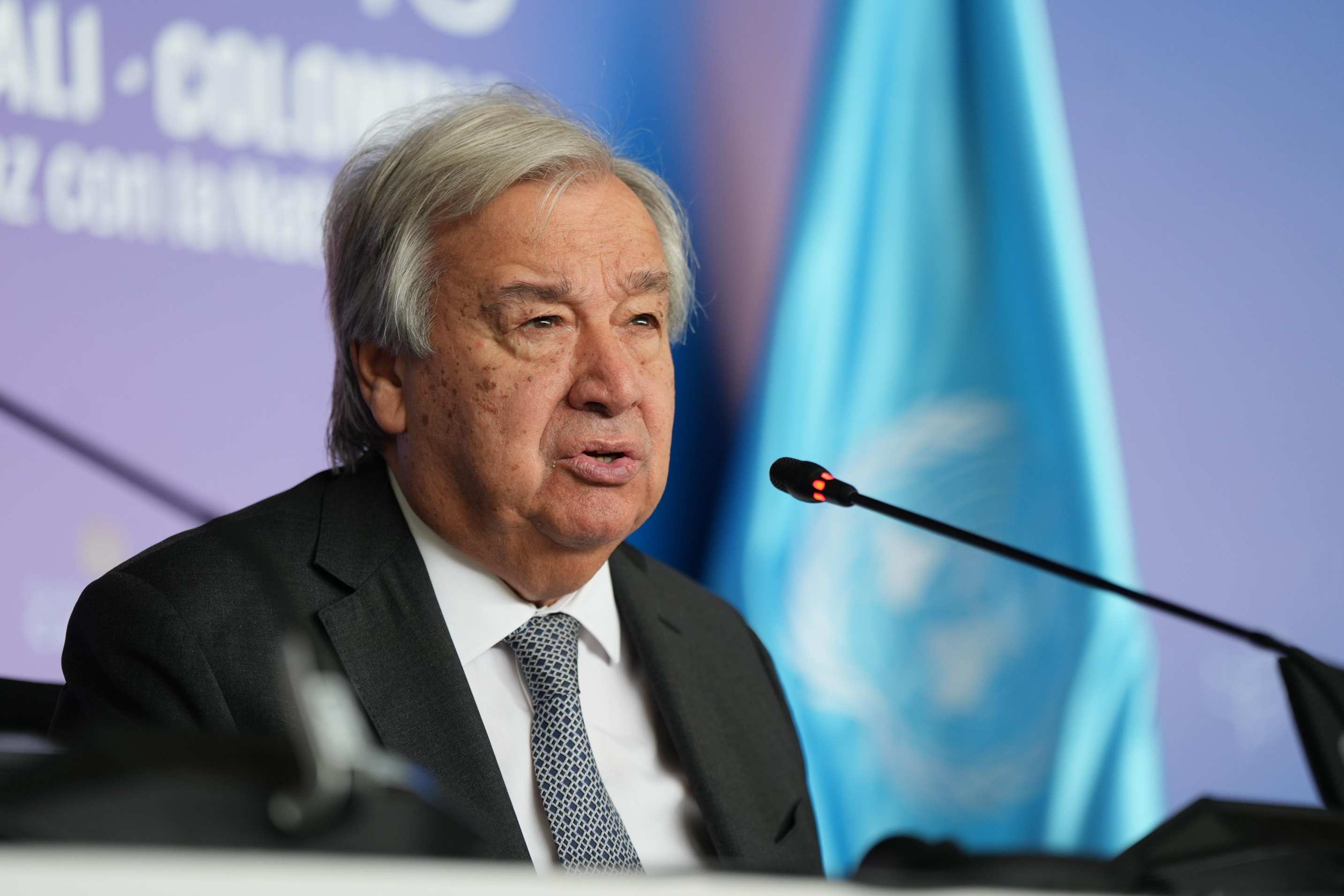
The United Nations Secretary-General, António Guterres, on Thursday issued a stark warning that rising tensions between the United States, Israel, and Iran risk spiralling out of control, with potentially devastating consequences for civilians and the global economy.
Speaking during a joint press encounter with António Costa, President of the European Council, Guterres called for an immediate halt to hostilities and urged a return to diplomacy and adherence to international law.
“First, to the United States and to Israel, it’s high time to end this war that is risking to get completely out of control,” he said, highlighting the humanitarian toll and the wider implications of the conflict beyond the immediate region. The Secretary-General warned that civilians are bearing the brunt of the violence, while global economic systems face serious disruptions.
“The propagation around the global economy is really dramatic with potential tragic consequences, especially for the least developed countries,” he added, stressing the risk of widespread economic fallout if tensions continue to rise.
Turning his attention to Iran, Guterres delivered a clear message urging restraint and condemning attacks beyond the conflict zone. “Second message, to Iran, stop attacking your neighbours, they were never parties to the conflict,” he said.
The Secretary-General’s warnings come amid escalating unrest across the Middle East, where fears of a wider confrontation are growing. He noted the actions already taken by the United Nations Security Council, including directives to cease hostilities and ensure that critical maritime routes remain open.
“The Security Council has condemned these attacks, has ordered them to stop, as it has ordered to open the Strait of Hormuz,” Guterres said. The Strait, a key route for global energy supplies, has become a focal point of concern, and the Secretary-General cautioned that prolonged disruptions there could have severe consequences worldwide.
“The prolonged closure of the Strait of Hormuz causes enormous pain in so many people around the world that have nothing to do with this conflict,” he said, highlighting the far-reaching impact on nations dependent on stable trade and energy flows.
Emphasising the need for a diplomatic approach, Guterres called for global actors to prioritise law over force. “It’s time for the force of the law to prevail over the law of the force. It’s time for diplomacy to prevail over war,” he said.
The press encounter also underscored the strong partnership between the United Nations and the European Union. Guterres expressed gratitude for the EU’s support and its role in advancing multilateral solutions.
“I want, naturally, to say that I’m extremely grateful for this invitation,” he said. “The European Union has been a fundamental support for the UN and for multilateralism.” Looking ahead, he expressed confidence that the EU would play a central role in shaping a more stable and rules-based global order.
“I hope, I’m sure, the European Union will be absolutely central in the efforts to create an international order based on the rule of law,” he said. Guterres also outlined a broader vision for the future, focused on justice, climate action, and stronger governance of emerging technologies.
“An international order in which we will have more justice, in which we will have more climate action, in which we will have more control of the evolution of technologies and in which international law will prevail,” he said, closing his remarks with a call for urgent global action to prevent further escalation and restore stability through dialogue.